
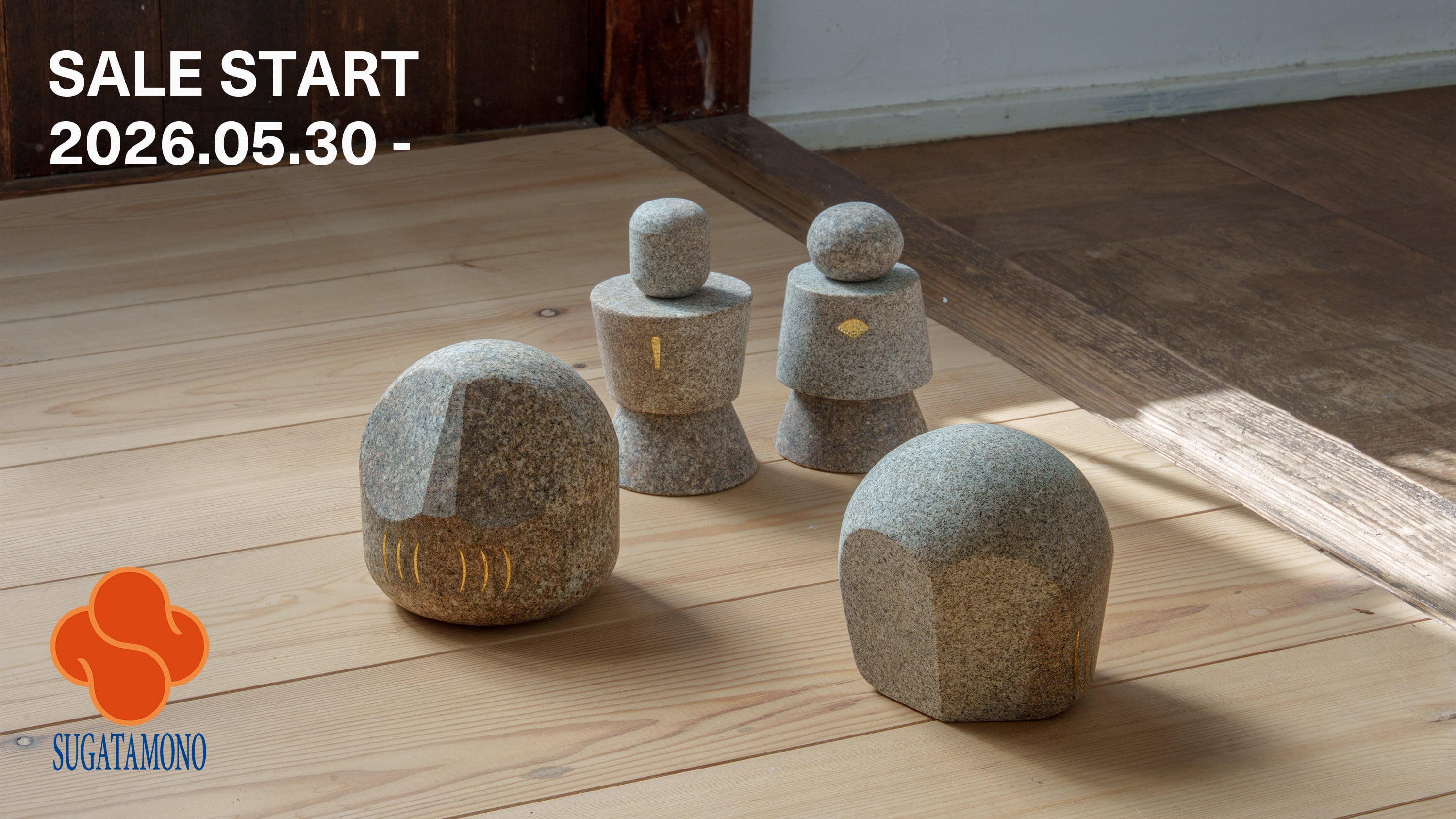
AOISHIMAから2026.05.30より、新ブランド「SUGATAMONO」の販売を開始いたします。
SUGATAMONOは、はっきりとした用途を持つ道具とは少し異なり、人の心にそっと寄り添う「姿物」をかたちにしていくブランドです。
そこに込められた想いや背景とともに、静かに暮らしの中に在り続ける存在を目指しています。
PRODUCT
-

だるま Daruma / SUGATAMONO
¥55,000
だるまは、インドから中国へ禅を伝えた高僧・達磨大師の座禅姿をもとに生まれた、日本の伝統的な縁起物です。ころんとした丸い形で、倒れても起き上がることから「七転び八起き」の象徴とされ、あきらめない心や粘り強さを表しています。江戸時代には、赤い色が魔除けになると信じられていたことから、天然痘よけのお守りとして広まりました。今では、家内安全や商売繁盛、合格祈願、成功祈願など、困難を乗り越えて願いをかなえたいという思いが込められた、親しみのある縁起物として大切にされています。 このだるまは、庵治石のサビ石を使って制作しています。褐色の石が持つやさしい丸みの中に、顔や鼻筋をイメージした面取りを施しているのが特徴です。 胴体には袈裟を表現した彫刻を施し、金箔で仕上げました。 The daruma is a traditional Japanese good-luck figure, inspired by the seated form of Bodhidharma, a monk who brought Zen teachings long ago. Its round shape gently rolls — but always rises again. It reflects the spirit of perseverance: no matter how many times you fall, you stand up again. In the Edo period, the color red was believed to protect against illness, and daruma became a familiar charm for safety and well-being. Today, they are kept close with wishes for happiness, success, and hopes yet to be fulfilled. This daruma is shaped from sabi-ishi, a warm brown Aji stone. Soft facets hint at the presence of a face, quietly emerging from the stone. The body carries a carved motif inspired by a monk’s robe, gently finished with gold leaf. Here, the quiet beauty of nature meets the touch of human hands — forming a small daruma that simply, and calmly, stands by your side. 素材:本体:庵治石(花崗岩)サビ サイズ:φ100 H100 (mm) 重量:1.8kg 付属品:桐箱 -- Photography : Yusuke Omata (7~9)

-

ひな人形 Hina dolls / SUGATAMONO
¥148,500
ひな人形は、子どもをけがや病気から守り、健やかな成長と幸せを願って飾られる、日本を代表する縁起物です。もともとは、人形に厄を移して身代わりになってもらうという意味があり、厄除けや良縁への願いが込められてきました。現在のひな人形は、天皇・皇后の結婚の儀を表した姿とされ、将来よいご縁に恵まれ、円満な家庭を築けるようにという願いも重ねられています。飾り始める時期は立春から雨水の頃がよいといわれ、特に雨水の日に飾ると良縁に恵まれるという言い伝えもあります。 このひな人形は、庵治石のサビ石を使って制作しています。褐色のやさしい表情と、積み木を重ねたようなシンプルなかたちの中で、男雛(おびな)と女雛(めびな)を表現しているのが特徴です。胴体には、それぞれ笏(しゃく)と檜扇(ひおうぎ)をイメージした彫刻を施し、金箔で仕上げました。 Hina dolls are a traditional Japanese symbol, displayed to protect children from illness and harm, and to wish for their healthy growth and happiness. Originally, they were believed to carry away misfortune, acting as a substitute to protect the person, and were associated with wishes for protection and good relationships. Over time, they came to represent the wedding of the Emperor and Empress, embodying hopes for a happy marriage and a harmonious future. They are typically displayed in early spring, from the beginning of spring to the season of rainwater, and it is said that placing them on the day of Usui (rainwater) brings good fortune in relationships. For these reasons, hina dolls carry wishes for growth, happiness, and a peaceful life. This piece is shaped from sabi-ishi, a warm brown Aji stone. Simple, stacked forms gently suggest the figures of the Emperor and Empress. The bodies are carved with motifs inspired by a ceremonial baton and a folding fan, and softly finished with gold leaf. Here, the quiet beauty of nature meets the touch of human hands — forming a small pair of hina dolls that gently stay by your side. 素材:庵治石(花崗岩)サビ サイズ:男雛 Φ70㎜×H120㎜ / 女雛 Φ70㎜×H110㎜ 重量:各0.7kg 付属品:台座(桜)/ 桐箱 -- Photography : Yusuke Omata (6~7)
-

ふくろう Owl / SUGATAMONO
¥55,000
ふくろうは、世界各地で「知恵」や「知識」、そして「幸運」の象徴とされてきました。日本では「不苦労(苦労しない)」「福来郎(福が来る)」といった語呂合わせから、縁起のよい存在として親しまれています。夜でもよく見える目や、くるりと大きく回る首の様子は、先を見通す力や金運、商売繁盛を連想させるものともいわれています。また、古代ギリシャでは知恵の女神アテナにゆかりのある鳥とされていたことから、知性や学びの象徴としても知られています。こうした背景から、ふくろうには学業成就や、幸せな人生への願いが込められています。 このふくろうは、庵治石のサビ石を使って制作しています。褐色の石が持つやさしい丸みの中に、顔をイメージした面取りを施しているのが特徴です。 胴体には羽を表現した彫刻を施し、金箔で仕上げました。 The owl has long been cherished around the world as a symbol of wisdom and good fortune. In Japan, it is also associated with wordplay such as fukurō (“no hardship”) and fukurō (“good fortune arrives”), making it a beloved auspicious figure. Its ability to see in the dark and its graceful turning head are often seen as signs of insight — the power to look ahead — and are linked to prosperity and success. In ancient Greece, the owl was sacred to Athena, the goddess of wisdom, and has long been a symbol of knowledge and learning. For these reasons, the owl carries wishes for academic success and a happy, fulfilling life. This piece is shaped from sabi-ishi, a warm brown Aji stone. Soft facets suggest the presence of a face, quietly emerging from the stone. The body is carved with a feather-like motif and gently finished with gold leaf. Here, the quiet beauty of nature meets the touch of human hands — forming a small owl that quietly watches over you. 素材:庵治石(花崗岩)サビ サイズ:φ100 H100 (mm) 重量:1.6kg 付属品:桐箱 -- Photography : Yusuke Omata (6~7)
-

鏡もち Kagami mochi / 二段 / SUGATAMONO
¥71,500
鏡もちは、お正月に飾られる日本の伝統的な縁起物で、年神様を迎えるための大切なお供えものです。丸いおもちを重ねた形は、人の魂や円満を表す「鏡」に由来するといわれ、家庭円満や無病息災、繁栄への願いが込められています。 二段重ねの鏡もちは、「月と太陽」や「過去と未来」などを表し、物事が円満に続いていくことを願う形です。上にのせる橙(だいだい)は「代々」に通じ、家が代々続いていくことを象徴しています。三段重ねは、さらに福や繁栄が重なっていくことを願う、より丁寧なお供えの形とされ、地域によっては竈の神様などに供えられることもありました。鏡もちは、新しい一年の健康と幸せ、そして家族の繁栄を願う気持ちを形にした縁起物として、今も大切に受け継がれています。 この鏡もちは、庵治石の中目を使って制作しています。表面にブラスト加工を施し、「餅とり粉」をまとったお餅のようなやわらかな質感を表現しました。 二段重ねと三段重ねの二種類展開です。 Kagami mochi is a traditional Japanese New Year’s decoration, offered to welcome the Toshigami — the deity of the new year. The form of two round rice cakes stacked together is said to be inspired by a mirror, symbolizing the soul and harmony. It carries wishes for family happiness, good health, and prosperity. The two layers are often seen as representing the sun and the moon, or the past and the future — a hope that life will continue in harmony. The small orange placed on top, daidai, is associated with the idea of continuity across generations, symbolizing a family that endures. A three-tiered form expresses an even deeper wish for growing fortune and abundance. In this way, kagami mochi embodies hopes for a healthy and happy year ahead, and continues to be cherished today. This piece is shaped from nakame, a type of Aji stone. Its surface is gently sandblasted to evoke the soft texture of powdered rice cakes. It is available in two forms: a two-tiered and a three-tiered composition. Here, the quiet beauty of nature meets the touch of human hands — forming a small kagami mochi that gently welcomes the new year. 素材:本体:庵治石(花崗岩)中目 サイズ:φ100 H70 (mm) 重量:1kg 付属品:桐箱 ※鏡もちを載せている高月(台)は今後別売で販売予定です。
-

鏡もち Kagami mochi / 三段 / SUGATAMONO
¥88,000
鏡もちは、お正月に飾られる日本の伝統的な縁起物で、年神様を迎えるための大切なお供えものです。丸いおもちを重ねた形は、人の魂や円満を表す「鏡」に由来するといわれ、家庭円満や無病息災、繁栄への願いが込められています。 二段重ねの鏡もちは、「月と太陽」や「過去と未来」などを表し、物事が円満に続いていくことを願う形です。上にのせる橙(だいだい)は「代々」に通じ、家が代々続いていくことを象徴しています。三段重ねは、さらに福や繁栄が重なっていくことを願う、より丁寧なお供えの形とされ、地域によっては竈の神様などに供えられることもありました。鏡もちは、新しい一年の健康と幸せ、そして家族の繁栄を願う気持ちを形にした縁起物として、今も大切に受け継がれています。 この鏡もちは、庵治石の中目を使って制作しています。表面にブラスト加工を施し、「餅とり粉」をまとったお餅のようなやわらかな質感を表現しました。 二段重ねと三段重ねの二種類展開です。 Kagami mochi is a traditional Japanese New Year’s decoration, offered to welcome the Toshigami — the deity of the new year. The form of two round rice cakes stacked together is said to be inspired by a mirror, symbolizing the soul and harmony. It carries wishes for family happiness, good health, and prosperity. The two layers are often seen as representing the sun and the moon, or the past and the future — a hope that life will continue in harmony. The small orange placed on top, daidai, is associated with the idea of continuity across generations, symbolizing a family that endures. A three-tiered form expresses an even deeper wish for growing fortune and abundance. In this way, kagami mochi embodies hopes for a healthy and happy year ahead, and continues to be cherished today. This piece is shaped from nakame, a type of Aji stone. Its surface is gently sandblasted to evoke the soft texture of powdered rice cakes. It is available in two forms: a two-tiered and a three-tiered composition. Here, the quiet beauty of nature meets the touch of human hands — forming a small kagami mochi that gently welcomes the new year. 素材:本体:庵治石(花崗岩)中目 サイズ:φ100 H90 (mm) 重量:1.2kg 付属品:桐箱 ※鏡もちを載せている高月(台)は今後別売で販売予定です。
-

GIRA / KUTARQ STUDIO
¥17,600
重厚で穴の空いた真鍮製の円柱が花崗岩の土台の上に置かれたお香立てです。 この円柱はお香の角度を変えられるため、作品に動きと遊び心を与えます。 また、円柱を垂直に立てれば、コーン型のお香用の香立てとしても使えます。 この作品を、スペイン語で「回る」を意味する「GIRA」と名付けました。 素材 : 庵治石(花崗岩)、真鍮 サイズ : 石部分 W160 D20 H15 (mm) 真鍮部分 Φ20 D20 (mm) 重量 : 石部分 150 (g) 真鍮部分 60 (g) I started playing with basic geometrical shapes: a cylinder and a box. A heavy perforated brass cylinder sits on a granite stone base, subtracting part of its section. The cylinder allows change the incense stick angle, making the piece dynamic and playful. The cylinder can also be placed vertically to serve as an incense cone burner. I named the piece GIRA, the Spanish word for 'Turn'. Material: Aji stone (granite)、Brass Size: Stone Part W160 D20 H15 (mm) Brass Part Φ20 D20 (mm) Weight:Stone Part 150 (g) Brass Part 60 (g)
-

Candle Base Asanoha - Gold / JURY KAWAMURA
¥33,000
JURY KAWAMURA氏によりデザインされたキャンドルホルダー。 立方体に加工された庵治石にキャンドル用の凹部を設けています。天面と側面には麻の葉模様の彫刻を施し彫刻部分には漆芸装飾技法の一つ「蒟醤(きんま)技法」で漆を埋め込んでいます。 素材:庵治石(花崗岩)|細目 サイズ:W60 D60 H60 (mm) --- Candle holder designed by JURY KAWAMURA. Aji stone, processed into a cube, has recesses for candles. The top and sides are carved with a hemp leaf pattern. The carved parts are embedded with lacquer using the "KINMA" technique, one of the lacquer decoration techniques. Material:Aji Stone (Granite) | speckled-grey Size:W60 D60 H60 (mm)
-

Candle Base Asanoha - White / JURY KAWAMURA
¥33,000
JURY KAWAMURA氏によりデザインされたキャンドルホルダー。 立方体に加工された庵治石にキャンドル用の凹部を設けています。天面と側面には麻の葉模様の彫刻を施し彫刻部分には漆芸装飾技法の一つ「蒟醤(きんま)技法」で漆を埋め込んでいます。 素材:庵治石(花崗岩)|細目 サイズ:W60 D60 H60 (mm) --- Candle holder designed by JURY KAWAMURA. Aji stone, processed into a cube, has recesses for candles. The top and sides are carved with a hemp leaf pattern. The carved parts are embedded with lacquer using the "KINMA" technique, one of the lacquer decoration techniques. Material:Aji Stone (Granite) | speckled-grey Size:W60 D60 H60 (mm)
-

HANA / Ichiro Yamaguchi
¥16,500
山口一郎氏のイラストを彫刻した庵治石製のプレート。 素材 : 庵治石(花崗岩) サイズ : W100 × D100 × H5 mm 重量 : 270g Aji stone plate engraved with an illustration by Ichiro Yamaguchi. Material: Aji stone (granite) Size: W100 x D100 x H5 mm Weight: 270g
-

owl / Ichiro Yamaguchi
¥16,500
山口一郎氏のイラストを彫刻した庵治石製のプレート。 素材 : 庵治石(花崗岩) サイズ : W100 × D100 × H5 mm 重量 : 270g Aji stone plate engraved with an illustration by Ichiro Yamaguchi. Material: Aji stone (granite) Size: W100 x D100 x H5 mm Weight: 270g
-

瀬戸内 - SETOUCHI - / Ichiro Yamaguchi
¥16,500
山口一郎氏のイラストを彫刻した庵治石製のプレート。 素材 : 庵治石(花崗岩) サイズ : W100 × D100 × H5 mm 重量 : 270g Aji stone plate engraved with an illustration by Ichiro Yamaguchi. Material: Aji stone (granite) Size: W100 x D100 x H5 mm Weight: 270g
-

屋島 - YASHIMA - / Ichiro Yamaguchi
¥16,500
山口一郎氏のイラストを彫刻した庵治石製のプレート。 素材 : 庵治石(花崗岩) サイズ : W100 × D100 × H5 mm 重量 : 270g Aji stone plate engraved with an illustration by Ichiro Yamaguchi. Material: Aji stone (granite) Size: W100 x D100 x H5 mm Weight: 270g
-

DISK I / HIMAA
¥12,100
平山昌尚氏のイラストを刻印した庵治石製のプレート。 素材 : 庵治石(花崗岩) サイズ : Φ80 × H5 mm 重量 : 160g Aji stone plate engraved with an illustration by Masanao Hirayama. Material: Aji stone (granite) Size: Φ80 × H5 mm Weight: 160g
-

DISK II / HIMAA
¥12,100
平山昌尚氏のイラストを刻印した庵治石製のプレート。 素材 : 庵治石(花崗岩) サイズ : W100 × D80 × H5 mm 重量 : 200g Aji stone plate engraved with an illustration by Masanao Hirayama. Material: Aji stone (granite) Size: W100 × D80 × H5 mm Weight: 200g
-

DISK III / HIMAA
¥12,100
平山昌尚氏のイラストを刻印した庵治石製のプレート。 素材 : 庵治石(花崗岩) サイズ : W100 × D80 × H5 mm 重量 : 200g Aji stone plate engraved with an illustration by Masanao Hirayama. Material: Aji stone (granite) Size: W100 × D80 × H5 mm Weight: 200g
-

DISK IV / HIMAA
¥12,100
平山昌尚氏のイラストを刻印した庵治石製のプレート。 素材 : 庵治石(花崗岩) サイズ : W100 × D80 × H5 mm 重量 : 200g Aji stone plate engraved with an illustration by Masanao Hirayama. Material: Aji stone (granite) Size: W100 × D80 × H5 mm Weight: 200g
-

DISK V / HIMAA
¥13,200
平山昌尚氏のイラストを刻印した庵治石製のプレート。 素材 : 庵治石(花崗岩) サイズ : Φ100 × H5 mm 重量 : 245g Aji stone plate engraved with an illustration by Masanao Hirayama. Material: Aji stone (granite) Size: Φ100 × H5 mm Weight: 245g
-

PHONE / HIMAA
¥19,800
平山昌尚氏デザインの庵治石製PHONEです。 充電ケーブルを挿すための穴はありますが、充電はできません。 素材 : 庵治石(花崗岩) サイズ : W72 × D147 × H8 mm A PHONE made of Aji stone, designed by Masanao Hirayama. There's a charging port, but it's not charging. Material: Aji stone (granite) Size: W72 × D147 × H8 mm
-

DICE I / HIMAA
¥16,500
平山昌尚氏デザインの遊び心溢れる庵治石製のサイコロです。 素材 : 庵治石(花崗岩) サイズ : W25 × D25 × H12.5 mm 重量 : 40g A playful dice made of Ajiishi stone, designed by Masanao Hirayama. Material: Aji stone (granite) Size: W25 × D25 × H12.5 mm Weight: 40g
-

DICE II / HIMAA
¥16,500
平山昌尚氏デザインの遊び心溢れる庵治石製のサイコロです。 素材 : 庵治石(花崗岩) サイズ : W25 × D25 × H25 mm 重量 : 85g A playful dice made of Ajiishi stone, designed by Masanao Hirayama. Material: Aji stone (granite) Size: W25 × D25 × H25 mm Weight: 85g
-

DICE III / HIMAA
¥16,500
平山昌尚氏デザインの遊び心溢れる庵治石製のサイコロです。 素材 : 庵治石(花崗岩) サイズ : W25 × D25 × H50 mm 重量 : 180g A playful dice made of Ajiishi stone, designed by Masanao Hirayama. Material: Aji stone (granite) Size: W25 × D25 × H50 mm Weight: 180g
-

TY BOOKSTAND / komame
¥88,000
「17時からの建築家」建築家・香川県職員であった故 山本忠司氏がデザインしたブックスタンドです。 【受注生産】 こちらの商品はご注文後制作いたします。発送までに1ヶ月ほどお時間をいただきます。 素材 : 庵治石(花崗岩) サイズ / 重量 : 凸 ー W135 × D150 × H150 / Φ110 (mm) / 5.45kg 凹 ー W75 × D150 × H150 / Φ115 (mm) / 3.5kg A bookstand designed by the late Tadashi Yamamoto, an architect and former Kagawa Prefectural government employee, often referred to as the "After-5 Architect" [Built-to-Order] This product is made to order. Please allow approximately one month for shipping after your order is placed. Material: Aji stone (granite) Size / Weight: convex ー W135 × D150 × H150 / Φ110 (mm) / 5.45kg concave ー W75 × D150 × H150 / Φ115 (mm) / 3.5kg
-

TY BOOKSTAND / sabi
¥88,000
「17時からの建築家」建築家・香川県職員であった故 山本忠司氏がデザインしたブックスタンドです。 【受注生産】 こちらの商品はご注文後制作いたします。発送までに1ヶ月ほどお時間をいただきます。 素材 : 庵治石(花崗岩) サイズ / 重量 : 凸 ー W135 × D150 × H150 / Φ110 (mm) / 5.45kg 凹 ー W75 × D150 × H150 / Φ115 (mm) / 3.5kg A bookstand designed by the late Tadashi Yamamoto, an architect and former Kagawa Prefectural government employee, often referred to as the "After-5 Architect" [Built-to-Order] This product is made to order. Please allow approximately one month for shipping after your order is placed. Material: Aji stone (granite) Size / Weight: convex ー W135 × D150 × H150 / Φ110 (mm) / 5.45kg concave ー W75 × D150 × H150 / Φ115 (mm) / 3.5kg
